
On a ferryboat
Carrying on with the help of myth (also a promotion for an art show my work is in starting tomorrow)

This man feels stressed. He feels like he’s going from thing to another without having a solid path.
Is he living a life he doesn’t want to be living?
No.
He wishes he could do more steady writing and create in ways that aren’t so much reaching out about this event or that event.
(By the way, his collage art is in a show in Chicago starting this coming Monday [actually tomorrow, I wrote the beginning of this essay two days ago]:

https://www.instagram.com/reel/DZIqyRySTxw/?utm_source=ig_web_copy_link&igsh=NTc4MTIwNjQ2YQ==
This Mon [actually tomorrow] is the opening. June 28th, they’ll be a second opening, and the art will be hanging up in the bar till August 10th).
It’s not like he wants to be sitting behind his typewriter all day working on his novel for stretches of days in a row. Sounds well and good, but he gets into it, and he burns out, wants to do another kind of art.
This man doesn’t know what he wants right now. He knows after breakfast, he’ll get his work set up in frames for the show. Later, he’ll check out a store to look for a garment for his part in a burlesque show on the 14th. All while remaining in touch with people over the phone.
He thinks finding peace with this might be about focusing on the life in front of him, the life that he can see two days in front of him — other than when he’s traveling of course — and go from there but even with traveling changing up things on the fly can be needed; the unexpected happens.
He feels he’s constantly looking to other ways of life or other activities. It’s the overwhelming overabundance of choice. Life in capitalism and the United States seems to be constantly throwing us things that are new and shiny to step into, or old and nostalgic to be returned to. With these things/areas of interest, it can be easy to say I want this instead of what I have when one doesn’t know what this new thing/nostalgic thing will really be like. But we know what it’s like to be doing what we’re doing right now.
This man is getting ready for that burlesque show. He’s getting ready for his art to be in the show next week. He’s collaborating on an art project that’s monthly at a local bar. He’s writing regularly online and sewing/customizing clothing and making collages.
Does he really need to drop what he’s doing? Or change up what he’s doing? He doesn’t think he’s fully appreciating where he’s at right now. Yeah, he’s happy with where he’s at. He likes this.
This grass is greener on the other side place he sometimes finds himself reminds him of the Joseph Campbell lectures he’s watching.
In this video, Campbell talks about the Buddha’s journey on a raft to break free from suffering. Campbell transposes the story to a modern person being fed up with their life in Manhattan and seeing New Jersey on the other side of the river. Once they take the ferry boat though, they can’t return. They have to stay in Jersey. They decide to take it.
A tangent (or is it?):
Speaking of ferry boats, this man, he did a tarot reading recently. He asked the cards, “How can slowing down for me lead to happiness and abundance?”
The deck provided him with this card:
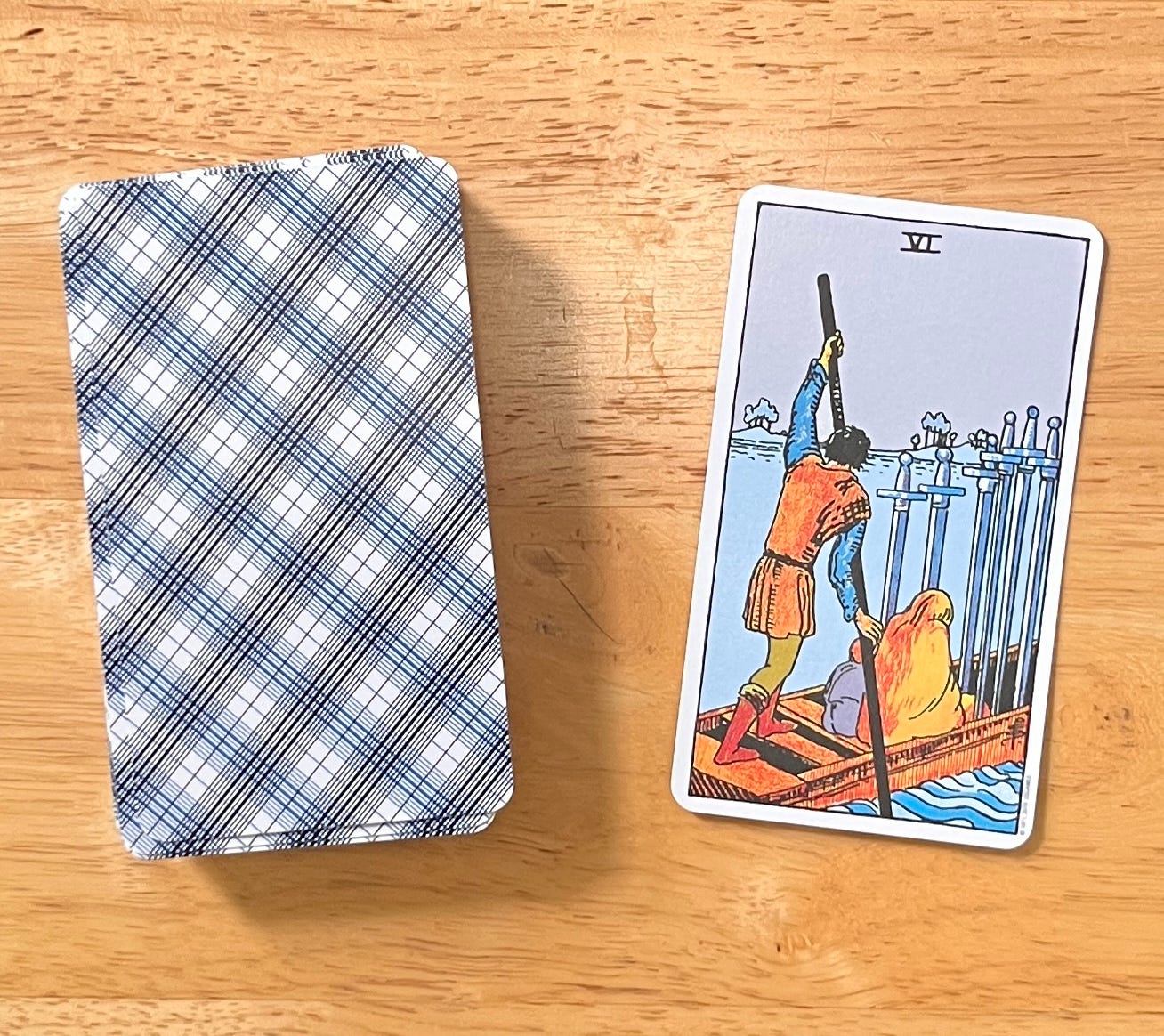
He likes Rachel Pollack’s interpretation of Six of Swords from her book, “Seventy-eight Degrees of Wisdom”:
*Ferryboat at twilight, carrying shrouded figures to a wooded isle, suggests spiritual journey of great silence — Charon (the ferryman of the Greek underworld) carrying the dead across the River Styx. Can indicate mourning, quiet passage through difficult time.
*Swords, light; they do not weigh down the boat. “As we have adapted to our troubles they will not weigh us down.”
*functioning in difficult situations without attacking the problem. Mourning that’s gone on for years, that a person’s felt for so long but no longer gives him power.
*The black oar —>potentiality —>nothing final has happened, all things have remained possible
Images on drawn cards often include the question instead of answering it. The journey may not be about finding happiness and abundance but might be about slowing down and accepting troubles and pain.
Leads back into what Campbell arrived at.
Modern man (Campbell depicts the modern person as a he/man) once he reaches Jersey experiences rapture. The arrival. The this is it feeling, I’m here (for me, I think of when I’m starting a new project or when I first learned to sew — this is so cool excitement, wide-eyed newness), but one quickly finds challenges and cannot escape suffering. The path remains difficult. Jersey may be their new path, but it’s still difficult. No matter, they must trudge and carry on. (This, Campbell refers to as “little ferry boat Buddhism” or Himayana [what’s now considered Theravada Buddhism]). This approach I believe most closely resembles the Six of Swords and Pollack’s interpretation. There’s a carrying on through difficulty about that card.
But Campbell goes on. Modern man once in Jersey and after experiencing rapture, realizing Jersey might not have been what he expected it to be, decides to turn around to look at from whence he came. There’s the Manhattan skyline in all its glory like a spectacular, glorious promised land. But he remembers the pain he suffered there, and the path he’s chosen in Jersey.
Jersey’s difficulty is very similar to the difficulty he experienced in Manhattan. The duality between Jersey and Manhattan dissolves. He transcends duality and taps into non-duality. He sees the likeness in the multiplicity of all things in the universe and is able to participate in life, suffering, happiness, sorrows with energy and aliveness. Life to him is discipline in enjoyment and to bring a joy everywhere he finds himself. Playing one’s part in the play of life and doing so more than willingly.
Campbell goes on to compare the Buddha’s journey on a ferry boat to Christ’s journey.
Just as the Buddha transcends into the joyful participation in the world, so does Christ, “in his love for the world coming to be crucified participating in the crucifixion.” Campbell’s reading of the imitation of Christ: “The joyful participation in the sorrows of the world.”
These ancient myths and religions repeat similar narratives and similar messages. To me they’re saying that there are paths out of the inactivity, despair, and fear responses that might come out an overabundance of choice. (I was feeling my fear response of flight there — impulse to drop everything.)
I think there’s validity and helpfulness to all the paths highlighted, but since I’m specifically working with the Tarot and going to that more for my own spiritual journey, I am following its guidance.