
Paper Ephemera and Monetary Values
my musings on tapping into that "precious" feeling

How do I define treasure?
Merriam-Webster defines it as:
noun: 1) wealth, stored up or hoarded 2) something of great worth or value
verb: 1) to hold or keep as precious 2) to collect and store up for future use
I gravitate toward the first definition of the verb form, particularly the word “precious”. Gosh, I sound like Sméagol from the Lord of the Rings:
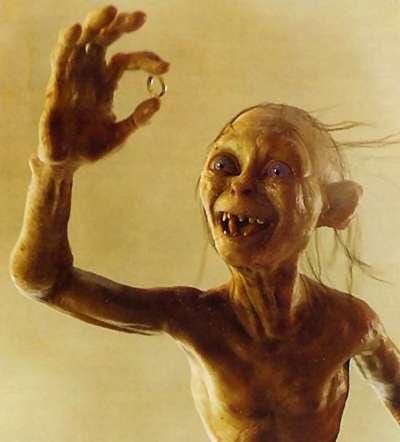
“Precious” points to a monetary value, and there’s a thrill when stumbling upon something and knowing this is worth money.
But to me, “precious” includes more than money. Merriam-Webster defines “precious” as “of great value or price,” as “highly esteemed or cherished,” and as “excessively refined.” All of these qualities, I believe mix together to form a witch’s brew, a magical potion.
Something is treasure and precious when it’s a material object and exerts a gravitational pull on its subject/person and the person becomes transfixed. One could call this pull a spell.
We see this in Lord of the Rings. The ring is made of gold (monetary value). Sméagol and other characters like the Hobbits can’t stop searching for the ring; it’s rare and desired (esteemed or cherished). The ring was created by the Dark Lord Sauron in the Volcanic Mount Doom during the second age, and around it, is inscribed a script/language that is only of the Lord of the Rings and The Hobbit worlds (excessively refined).
I think we can take the term “precious” further too. PBS’s website describes how appraisers on the network’s popular show “Antiques Roadshow” determine the monetary value of antiques:
Value can change: The value of an item is dependent on many things, including the condition of the object itself, trends in the market for that kind of object, and the location where the item will be sold. This is why the answer to the question “What’s it worth?” is so often “It depends.” (https://www.pbs.org/wgbh/roadshow/understanding-our-appraisals/)
Appraisers determine value by adding two things together: trends in the market for an item (is it “highly esteemed or cherished”?) and condition (is it “excessively refined”?). And this value might change based on where an item is being sold — I think of location as “setting” in a literary sense, location can point to date or time too, not only place. For example, I wonder if I could’ve sold that baseball card (in my previous post about collecting) for at least $300 at the time I found it? Knowing that is informative for the present.
An equation when determining value:
Esteem or Trend + Refinement or Condition = Value or Price
And then, we combine all of these qualities and multiplying each one by individual mystery signifiers “X,” “Y,” “Z” to determine whether an item is “precious”:
EsteemX + RefinementY + ValueZ = precious or not
If the solution of those three is a certain level, then the item is “precious.”
(I’m aware. This might sound like some Aleister Crowley magic, alchemy, numerology stuff. I’m playing and experimenting so don’t judge me. Or if you do, bear with me. This may work/be helpful. Plus, I like doing this numerology stuff.)
The “X,” “Y,” “Z” signifiers are specific to the individual who is determining whether the item is precious or not: the appraiser, the owner, the buyer, or the seller. How much emphasis does a particular individual put on esteem, refinement, or value? For example, let’s go to what I’m interested in collecting and possibly might go on to sell now. Paperback books and other paper ephemera.
One day a couple years ago, I walked into a used bookstore here in Chicago that no longer exists. (I’m thinking it was closed down due to fire code violations.) Books packed ceiling-high cases, some books on spines, some on their edges, others hanging from their sides. A customer could easily be hit by a toppling book when walking through an aisle. But I liked this store because I could dig and possibly find something reasonably priced I was interested in.
Smell of old paper and cardboard filled the space. From the Modernist literature section, I shuffled over to French literature and philosophy. Scanned the titles, spines, and covers, gradually noting each book and asking internally if I was interested. I specifically paused over books that looked old to me because generally, I like old things. I could take my time.
No strangers were hovering around me trying to look at the exact same spot, encroaching on my personal space like what sometimes happens in stores like this in a big city. (How I’ve grown to deal with this though is to let the stranger take my spot and then, come back when they’re finished. It’s rare that they’re looking for the exact same thing I’m looking for anyway. The old books/antiques collecting world is unique and specific in individual tastes. We/people forget this and sometimes let feelings of competition take over.)
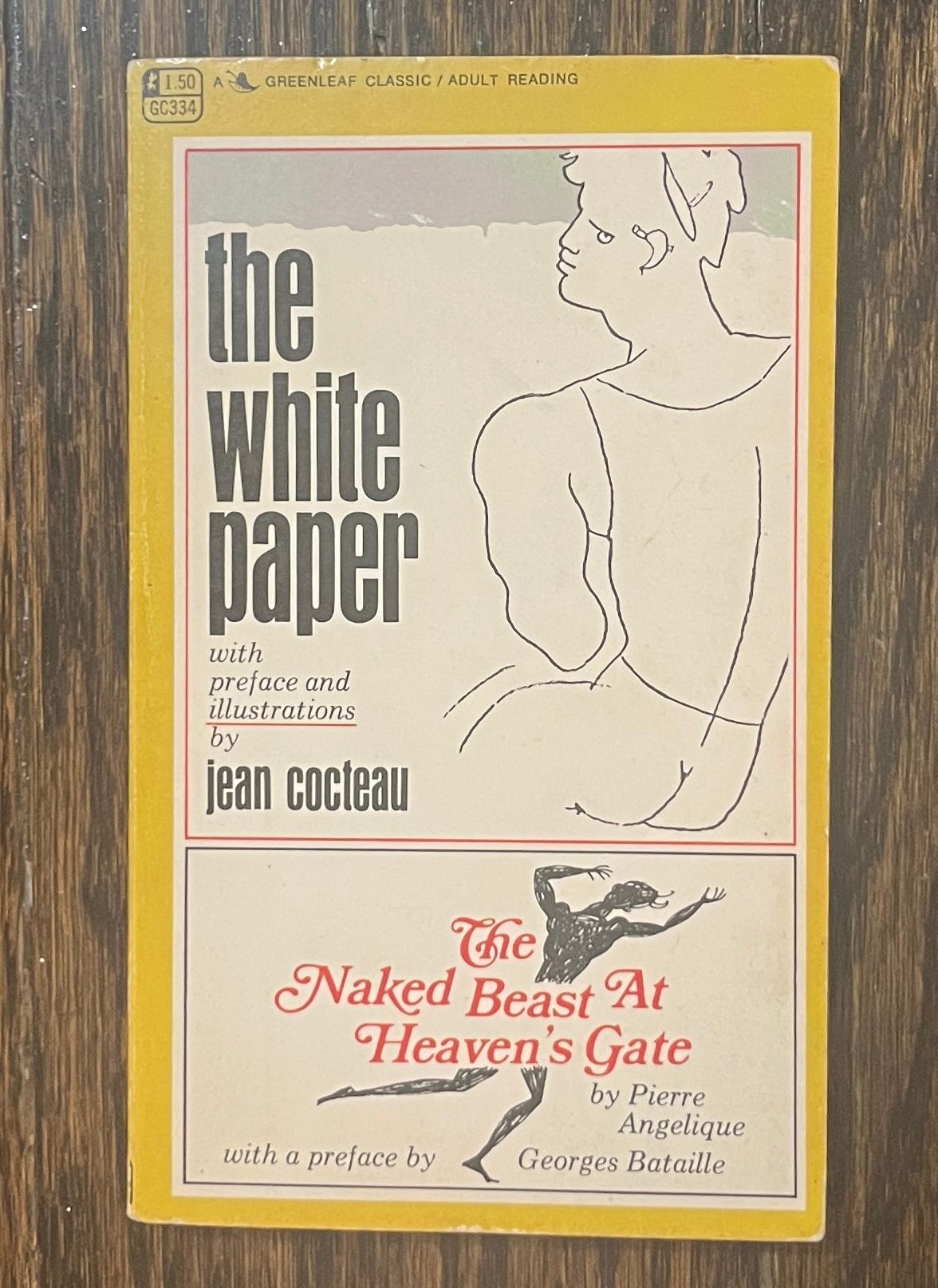
But yes, my eyes happened upon a little yellow paperback that sat on its back cover on top of other books. Its title in read lettering with yellow background: The White Paper / The Naked Beast at Heaven’s Gate. Given my reading interests, I might not have noticed the book had the “Naked Beast” part not been there. I carefully grabbed it, looked at the front, back, its pages. Oh, the author I’d heard of, Jean Cocteau. I knew he was a French filmmaker and author but not much more than that. And the book was in absolutely pristine condition for being a thin paperback from 1968. No other dates on the copyright page too so this could’ve been a first American edition at least.
Inside, there were drawings too!
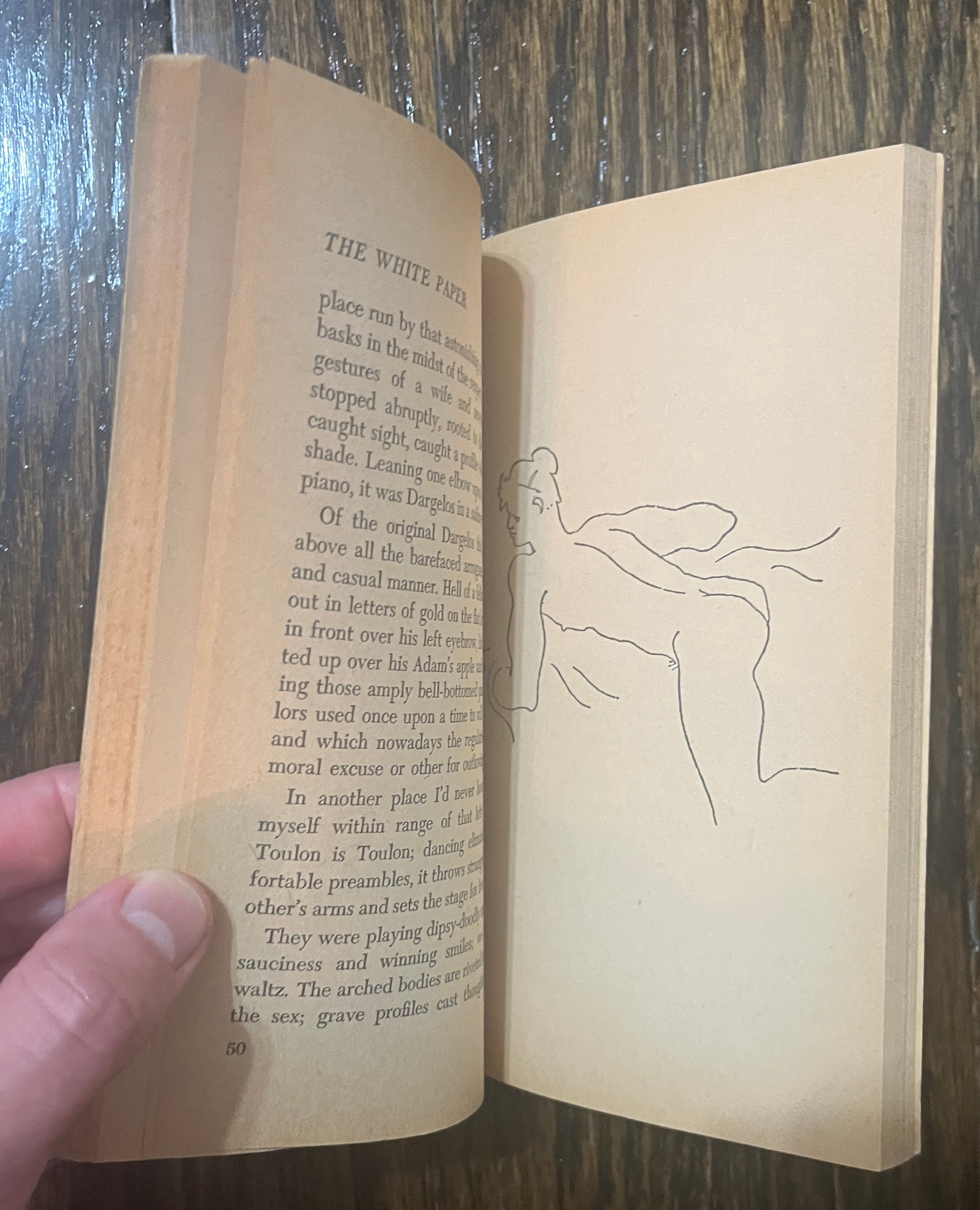
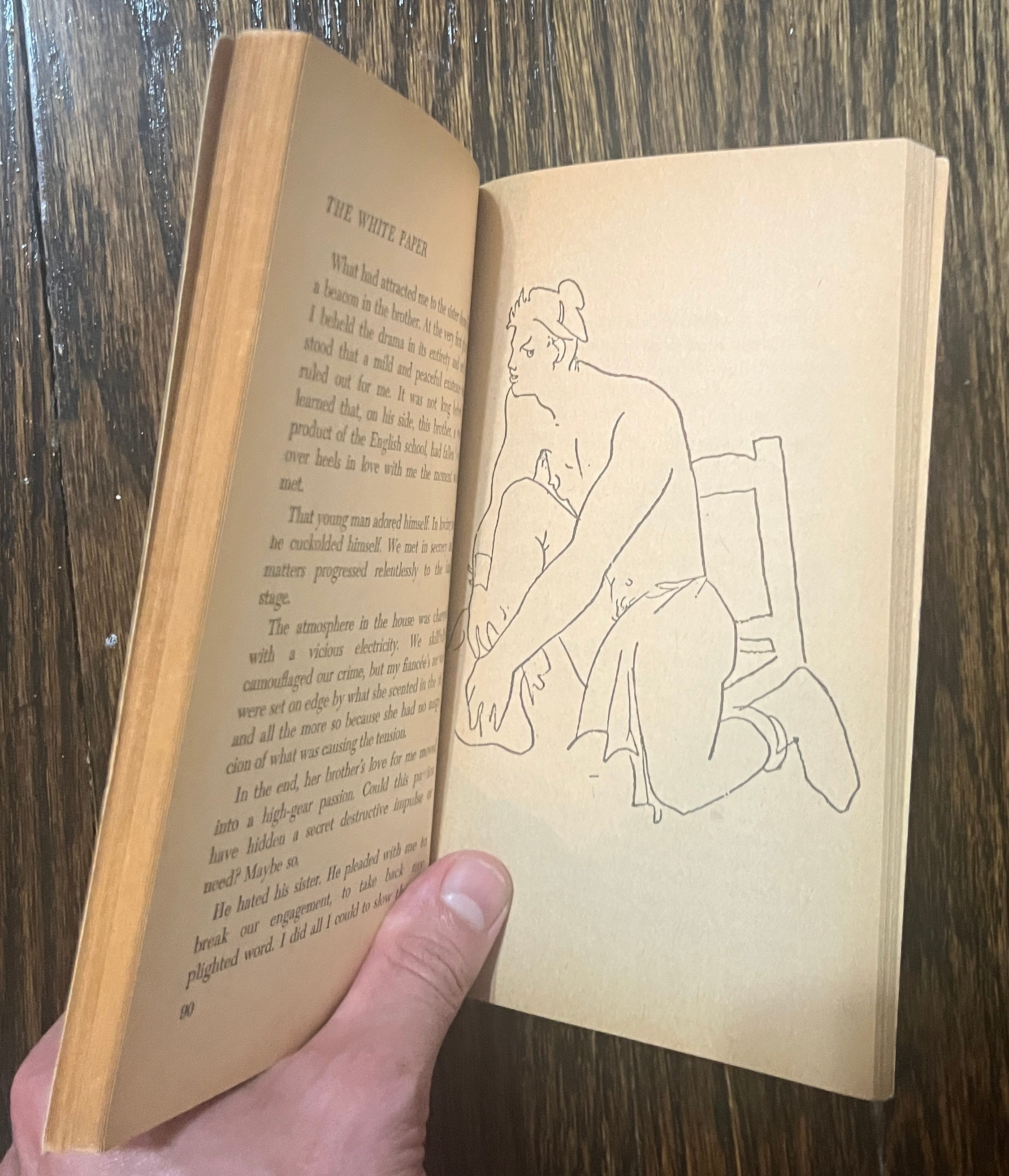
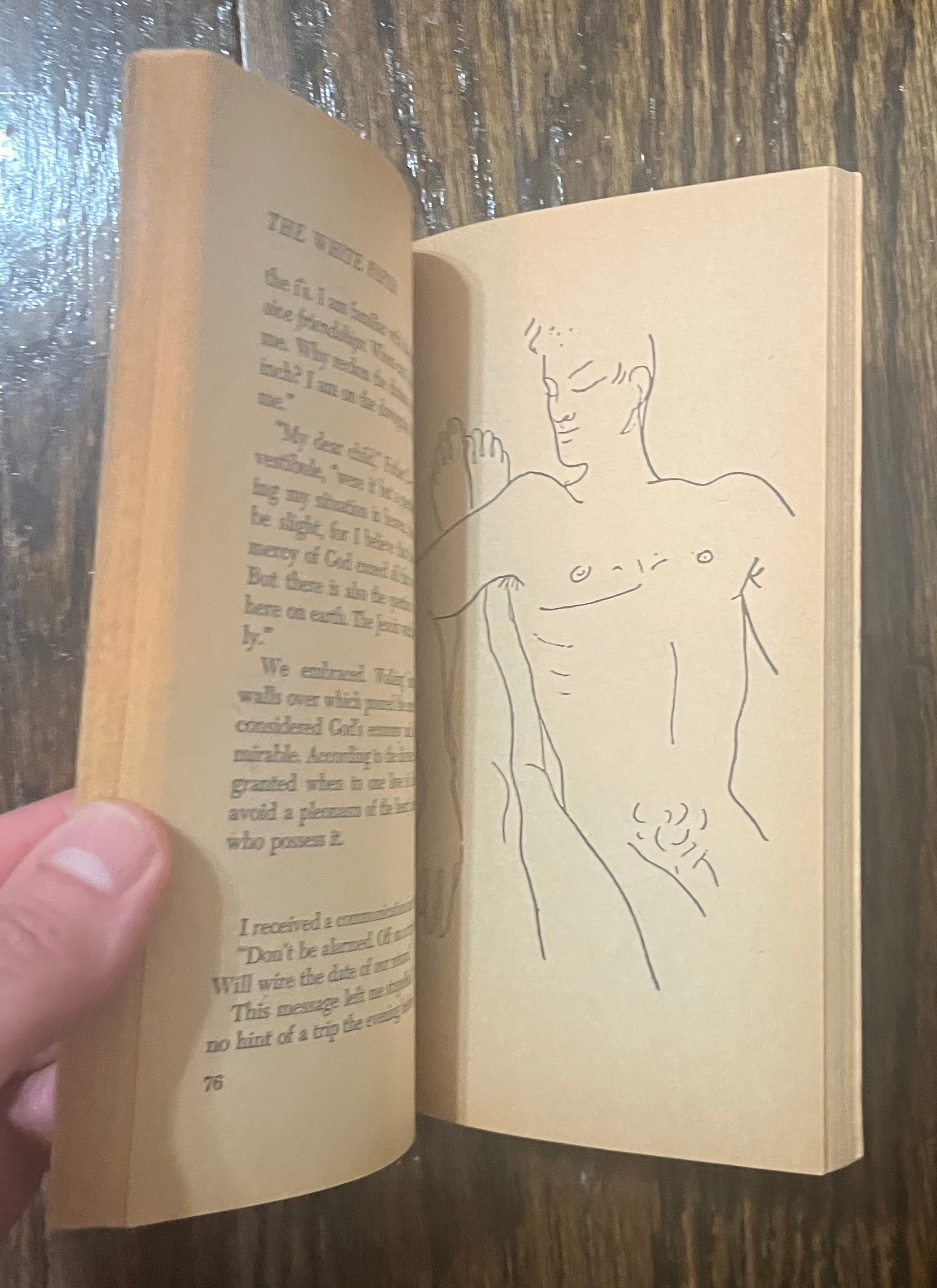
Even if I was overpaying for the book with its $15 price tag, I’d want to read it. Cocteau’s portion is about a character’s journey in finding out his sexuality and is a very open and strong expression of that sexuality. I might’ve found other items at the shop that day too. I checked out and when returning home searched for copies of the book that had sold on eBay. I remember seeing a comparable copy with this exact cover (there’s a pink cover one that seems more numerous and priced lower) that had sold for somewhere around $75. That feeling that came up with the McGwire card (from my previous Substack writing) arose again. Excitement, thrill, an electricity in my ankles started that made me want to jump. Even though in the big scheme of things, discovering something is worth $60 more than what one’s paid isn’t much, I still get a rush from that discovery. I think that reveals that my “Z” variable in the above equation might be fairly high. I admit; I like it when I find out something is worth money.
This item also reveals something about me in terms of a different variable. At home, I remembered Georges Bataille is a well-known French Modernist too and writer of erotic/obscene literature; I had read his obscene, other readers might say grotesque book Story of the Eye in undergrad. And that Pierre Angelique name? That’s a pseudonym for Bataille. This book contained a story by an author I’d been wanting to read, drawings by said author, and a story I hadn’t read by an author I had taken delight in reading — I enjoy writing and art that shocks and really goes against the grain. I wanted to read this book; yet, the risk I’d be taking in reading it.
Rare book collectors like books in better condition over ones that degraded, are torn, damaged, etcetera. The White Paper being an old pulp paperback, reading it I’d risk creasing the spine, tearing a page or two, cover shedding ink, but deep down to be honest, I really don’t care, outside of condition’s influence on the potential monetary value of an item, about the condition of a treasured vintage/antique object. I could find an old postcard, book, painting, and the object could be water-damaged and have dirt baked into it and a big part of me would hold that item and go, wow. It’s so cool. But then, I see what others would pay for it because of it’s condition, and I get disappointed.
The Y for me in the above equation (EsteemX + RefinementY + ValueZ = precious or not) is a lower number than probably some other peoples’.
I’m enjoying writing about these topics so I think I’ll be continuing these posts (the above one is definitely not finished).
I really appreciate you reading! Thanks for following and/or subscribing.
If you have any questions and/or comments, don’t hesitate to share too : )
Best and take care,
— Todd